 Klemio
Things to do in Budapest
Budapest is two cities pressed together across the Danube: hilly, quiet Buda with its castle on one bank, and flat, loud Pest with the grand boulevards and ruin bars on the other. The pull is the cheap thermal baths, the turn-of-the-century architecture, and a food-and-drink scene that punches well above the price. This guide covers when to go, how to get around on the cheap and good transit, the neighborhoods worth your time, and the day trips that earn an extra night.

The essential things to do in Budapest
-
The big yellow neo-baroque bath in City Park, best early morning or late evening since it jams up midday on weekends; bring flip-flops and a towel or rent them on site.
-
2. Hungarian Parliament Building.
The riverside icon, and the inside is worth it for the grand staircase and the crown jewels, but interior tours are timed and the English slots sell out, so book online well ahead.
-
3. Fisherman's Bastion and the Castle District.
The white fairy-tale terraces give you the postcard view across to Parliament; go early or near sunset to dodge the tour-group crush, and know the upper towers may charge a small fee.
-
Step inside for free, then pay separately to climb or take the lift up to the dome for one of the best 360 views over Pest's rooftops.
-
A quiet, gutting memorial of iron shoes along the river for Jews shot here in WWII; it takes five minutes and it stays with you.
-
6. Ruin bars in District VII.
Szimpla Kert started the whole genre, a sprawling junk-decor courtyard bar in the old Jewish quarter; fun once, packed and a bit theme-park now, so wander Kazinczy Street and pick your own spot too.
-
The largest synagogue in Europe, with a moving memorial garden out back; cover shoulders and knees, and men get a paper kippah at the door.
-
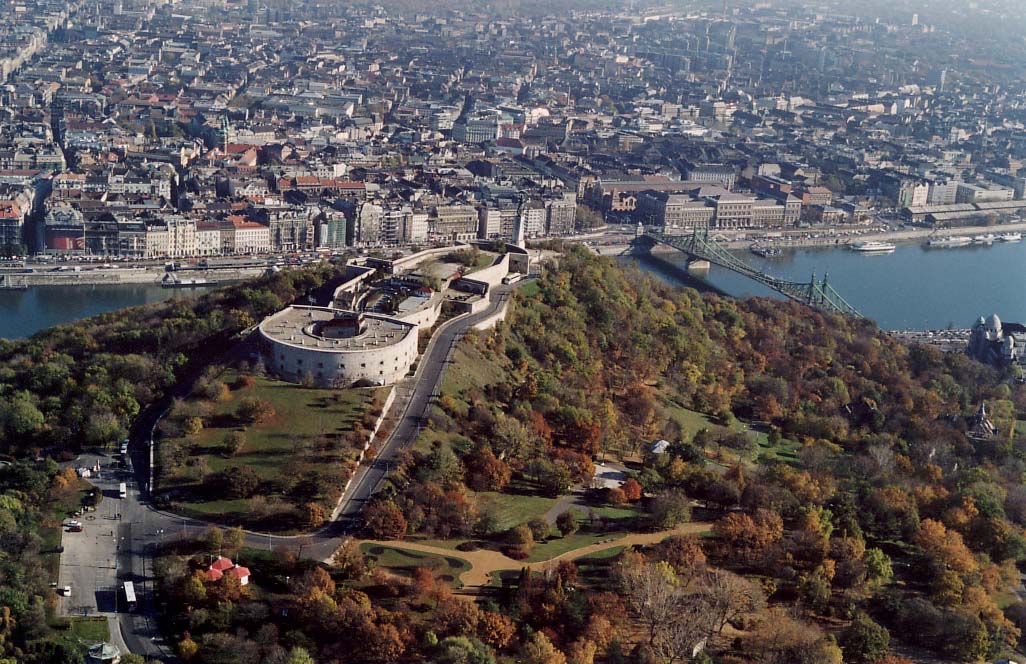
8. Gellért Hill and the Citadella.
A sweaty 20 to 30 minute climb up the Buda side for the widest view over both banks and all the bridges; good at golden hour, and you can pair it with the Gellért or Rudas baths below.
Landmark guides for Budapest


Plan your trip to Budapest
Thumbnail photos by Kilyann Le Hen (CC BY 4.0), Brian Adamson (CC BY 2.0), Varius (CC BY-SA 3.0), Marc Ryckaert (MJJR) (CC BY 3.0), Marc Ryckaert (MJJR) (CC BY 3.0), Nikodem Nijaki (CC BY-SA 3.0), Godot13 (Attribution), Julius Barclay (CC BY-SA 4.0), The original uploader was OsvátA at Hungarian Wikipedia. (CC BY-SA 3.0), Civertan Grafikai Stúdió (CC BY-SA 2.5), via Wikimedia Commons.
Why go to Budapest
The short version: it gives you a grand European capital at a fraction of the cost of Vienna or Prague, and it has one thing neither of them does, which is a whole culture of hot thermal baths you can soak in for the price of a couple of coffees. The architecture along the river is genuinely something, all the more so lit up at night, and the divide between the two halves of the city is real and worth leaning into. Buda is the hill, the castle, the leafy quiet. Pest is flat, dense, and where the nightlife and most of the eating happens.
It is also easy. The center is walkable, the transit is cheap and frequent, and the language barrier mostly disappears in tourist areas. The trade-off is that Budapest has been firmly discovered. The Castle District and the main ruin bars run heavily touristy, and prices in District V are not the bargain they were a decade ago. The fix is simple: eat and drink a few blocks off the obvious squares, and you get the value and the local feel back.
One practical thing to internalize before you arrive: this is a forint country, not a euro one. Plenty of places quote euros to tourists, but you almost always come out ahead paying in forint, and if a card machine offers to charge you in your home currency, say no and choose forint to avoid a bad built-in conversion rate.
When to visit
Late spring and early fall are the sweet spots. May into early June and September into October give you mild days, long light on the river, open terraces, and noticeably thinner crowds than peak summer. If you only get to pick a window, pick one of these.
Summer, July and August, is warm to hot and busy. The upside is the city in full swing: the outdoor pools at the baths come into their own, the ruin bars and festivals run hard, and Sziget lands in August and pulls a big crowd. The downside is heat, queues, and higher room rates. Winter flips the math. It is cold and often gray, but the baths are arguably at their best when it is freezing and steam pours off the water, and the Christmas markets at Vörösmarty Square and around the Basilica run through Advent.
The weakest stretch is November and the damp back half of winter, which can feel flat. The consolation is cheap rooms and short museum lines, so it is not a write-off if you are coming for indoor things and baths. Whenever you come in spring, the weather swings around a lot, so pack a layer you can shed.
Getting around
The center is compact and very walkable, and the public transport (BKK) is cheap and genuinely good, so you rarely need a taxi. There are four metro lines: M1, the little historic yellow line running under Andrássy Avenue out toward Heroes' Square and the baths; the red M2 and blue M3 crossing town; and the green M4. M1 is a sight in itself, one of the oldest electrified underground lines anywhere.
Often the trams beat the metro for both speed and views. Tram 2 runs right along the Pest embankment past Parliament with the river on one side, and is worth riding just for the ride. Trams 4 and 6 loop the Grand Boulevard around the clock. Buses fill the gaps, and bus 16 climbs up to the Castle if you would rather not walk or pay for the funicular. For most visitors the simplest deal is a 24-hour or 72-hour travelcard: unlimited rides and no per-trip math. If you buy single tickets instead, validate them the old-fashioned way when you board, because inspectors do check, especially on the metro.
Two airport notes. The 100E bus is the cheap, direct link between the airport and the center, but it needs its own dedicated fare; a normal single ticket does not cover it. Buy tickets in the BudapestGO app or at machines, since drivers do not reliably sell them. For cabs, stick to the Bolt app or the official Főtaxi, and do not hail random taxis off the street, which is the easiest way to get overcharged here.
What to do, by type of trip
First-timer, two or three days: do Parliament (booked ahead), the Basilica and its dome, a walk along the Pest embankment past the Shoes memorial, then cross the Chain Bridge to Buda for Fisherman's Bastion and the Castle District. Bank at least one bath, ideally a slow morning at Széchenyi. That is the classic spine of the city and it holds up.
Couples and slow travelers: this is a great soaking-and-eating city. Pair the baths with the cafe culture (the grand old coffeehouses, the terraces around Liszt Ferenc Square), an evening at the Opera House if there is something on, and dinner on Ráday Street or in Újlipótváros where it is more local. Gellért Hill at golden hour is the romantic view, and it is free.
Nightlife and groups: District VII, the old Jewish quarter, is the engine room, with Szimpla Kert and the ruin-bar cluster around Kazinczy Street, plus late-night street food. It is loud and crowded, which is the point, but pick your own bars rather than following anyone who approaches you on the street (more on that below). Families: the baths with outdoor pools, City Park, Margaret Island for green space and a stroll, and the M1 line as a low-effort way to get the kids to Heroes' Square and back.
How to plan your days
Geography should drive your itinerary, because crossing the river eats time. Group the Pest sights together: Parliament, the Basilica, Andrássy Avenue, Heroes' Square and the baths at the far end of it all sit on the Pest side and chain together well, partly along the M1 line. Do that as one day or a day and a half.
Give Buda its own block. Take bus 16 or the funicular up, then work through the Castle District, Matthias Church, and Fisherman's Bastion on foot before walking or riding down. Slot Gellért Hill onto this side too, and reward the climb with a soak at the Gellért or Rudas baths at the bottom. Trying to bounce back and forth across the bridges all day just wastes time on transit.
Build the baths in as a deliberate half-day, not an afterthought, and aim for early morning or evening to skip the worst weekend crowds at Széchenyi. If you are moving around a lot, the Budapest Card bundles transport with free or discounted entry to many sites and can pay off; if you are mostly walking and only hitting a couple of paid attractions, a plain travelcard plus individual tickets is usually cheaper. EU citizens and under-26s should carry ID, since some state museums give reduced or free entry.
Booking tips and common mistakes
Book the time-slotted things in advance. Parliament interior tours sell out, and the English-language slots go first, so reserve online before you arrive rather than turning up hopeful. The Basilica dome and many bath tickets also go smoother booked ahead, especially on summer weekends. For the baths, bring flip-flops and a towel or plan to rent them, most have lockers or cabins, and know that the after-dark 'sparty' parties are a separate ticketed event, not the normal bath experience.
Money and tipping: pay in forint, decline any card machine that offers your home currency, and check the bill before you tip, because some restaurants already add a service charge and you do not want to tip twice. A tip of roughly 10 to 15 percent is normal when service is not already included. For churches and the synagogue, cover shoulders and knees; men receive a paper kippah at the Dohány Street Synagogue.
Now the scams, because they are predictable here. Do not hail street taxis, and be wary of the friendly stranger or 'hostess' who invites you to a great bar nearby. The classic trap is exactly that: you get walked to a place, the drinks arrive, and the bill is enormous. Pick your own bar, check prices on the menu before you order, and ignore anyone touting for a venue on the street. Stick to those rules and Budapest is an easy, safe city to wander.
Where to stay and explore: Budapest's neighborhoods
- District V (Belváros-Lipótváros)
- The downtown core on the Pest side, with Parliament, the Basilica, the Danube promenade and the grand boulevards; central and convenient but the priciest place to sleep and eat.
- District VII (Erzsébetváros)
- The old Jewish quarter and the ruin-bar district, centered on Kazinczy Street and Szimpla Kert; great for nightlife and late food, but loud well into the small hours.
- Castle District (Várnegyed, Buda)
- The cobbled hilltop around Buda Castle, Matthias Church and Fisherman's Bastion; lovely to look at and very touristy, with little everyday local life once the tour buses leave.
- District VI (Terézváros)
- Andrássy Avenue, the Opera House and the cafe terraces of Liszt Ferenc Square; elegant, walkable, and a good base for an evening out without the District VII racket.
- District VIII (Józsefváros)
- Gritty and gentrifying, with the grand Palace Quarter on one side and rougher corners on others; cheaper and more local if you do not mind the unevenness.
- District IX (Ferencváros)
- South Pest near the Great Market Hall and the Bálna, with the restaurants of Ráday Street and a calmer residential feel that is still close to the center.
- District XIII (Újlipótváros)
- Just north of Parliament, a relaxed, cafe-heavy residential area with Margaret Island nearby; local and easy to like for a quieter stay.
- District I and II (Buda riverside / Víziváros)
- Quiet green hillsides under the castle, leafy and residential; good for a slower trip if you do not need nightlife on your doorstep.
Things to do in Budapest: FAQs
Two full days hit the essentials: one for the Pest side (Parliament, Basilica, the embankment, the baths) and one for Buda (the Castle District, Fisherman's Bastion, Gellért Hill). A third day lets you slow down, add a long bath session, or take a day trip like Szentendre.
Széchenyi is the big famous one with outdoor pools, best early morning or evening since it gets packed midday on weekends. Gellért is the grand art nouveau option, and Rudas has an Ottoman-era pool with great river views. Bring flip-flops and a towel or rent on site, and remember the night 'sparty' events are a separate ticket.
Yes. Parliament interior tours are timed and the English-language slots sell out, often days ahead in busy periods, so book online before you go. The Basilica dome and many bath tickets are also smoother reserved ahead, especially on summer weekends.
Forints. Hungary uses the forint, not the euro, and although some places quote euros, you usually get a worse rate paying that way. If a card machine asks whether to charge you in your home currency, always choose forint to avoid the bad built-in conversion.
The 100E bus is the cheap, direct link into the center, but it needs its own dedicated fare; a regular single or travelcard does not cover it. Buy that ticket in the BudapestGO app or at a machine before boarding, since inspectors check. Otherwise use the Bolt app or official Főtaxi for a cab.
It is a safe, easy city to walk, but two traps are common: overpriced street taxis (use Bolt or Főtaxi instead) and the 'friendly local' or hostess who walks you to a bar where the bill turns out huge. Pick your own bars, check menu prices before ordering, and ignore anyone touting a venue on the street.
Explore more destinations
- Things to do in Vienna Austria
- Things to do in Prague Czech Republic
- Things to do in London England
- Things to do in Paris France
- Things to do in Berlin Germany
- Things to do in Athens Greece
- Things to do in Naxos Greece
- Things to do in Dublin Ireland
- Things to do in Florence Italy
- Things to do in Rome Italy
- Things to do in Venice Italy
- Things to do in Tokyo Japan
- Things to do in Amsterdam Netherlands
- Things to do in Lisbon Portugal
- Things to do in Porto Portugal
- Things to do in Barcelona Spain
- Things to do in Madrid Spain
- Things to do in Dubai United Arab Emirates
- Things to do in Las Vegas USA
- Things to do in New York City USA
Where to next?
One short email, twice a month: handpicked experiences, hidden-gem cities, and the best windows to book them.