 Klemio
Memorial to the Murdered Jews of Europe
Peter Eisenman's field of around 2,700 gray concrete slabs sits a couple of minutes from the Brandenburg Gate, and walking into it is the point: the ground dips, the slabs rise over your head, and the noise of the city drops away. It is free and open all the time, but the underground information center beneath it is where the abstraction becomes human, so leave time for that. One thing to know going in: this is a place of mourning, not a backdrop, and climbing or posing on the slabs reads as exactly as disrespectful as it is.
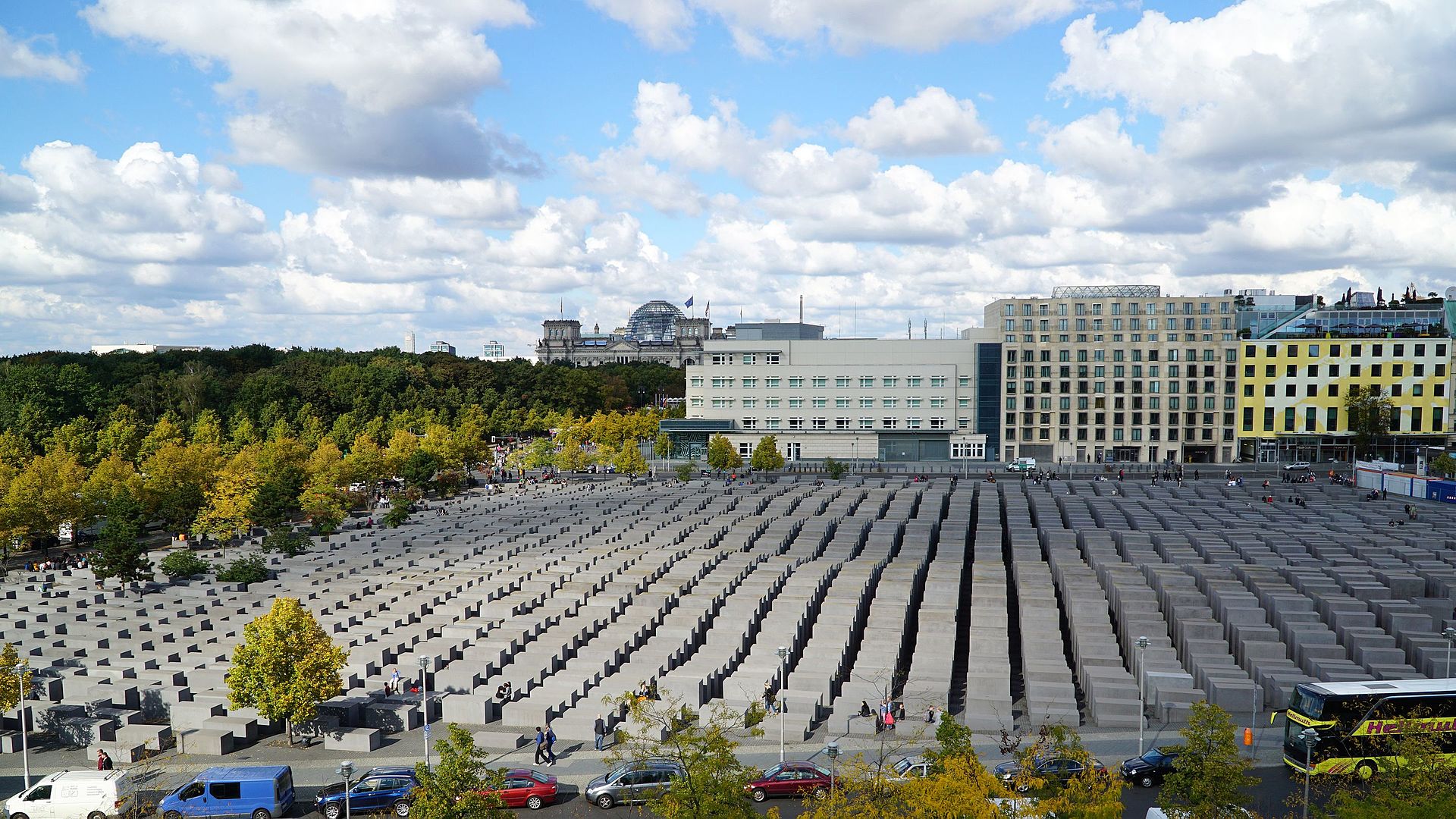
Photos: Pudelek (Marcin Szala) (CC BY-SA 3.0), Slaunger (CC BY-SA 3.0), Slaunger (CC BY-SA 3.0), via Wikimedia Commons
Go, and do not skip the information center underneath, because that is where the gray slabs above turn into real names and real lives. It is free, it is central, and it is one of the most affecting things in Berlin. Come early or late, walk it slowly, and behave like you are in a cemetery, because you essentially are.
Worth it for
- Anyone trying to understand Berlin's reckoning with its history
- Visitors who want the field and the deeply moving underground exhibition
- Quiet early-morning or evening walks
You can skip if
- You only want light, upbeat sightseeing and are not in the headspace for it
- You are visiting during the early-2026 renovation and specifically wanted the indoor exhibition
Tickets & tours for Memorial to the Murdered Jews of Europe
Which ticket should you buy?
What it is
The memorial covers a large open block with roughly 2,700 concrete stelae of varying heights, set in a grid on undulating ground. There is no single entrance, no plaque on each slab, and no prescribed route. You just walk in. As you move toward the center the slabs grow taller and the floor sinks, until you are alone in narrow gray corridors with the sky in a strip overhead.
Eisenman deliberately refused to explain the design, and people read it differently: a graveyard, a maze, an ordered system gone disorienting. That ambiguity is the work. It does not tell you what to feel, which is part of why it lands harder than a more literal monument would.
The information center below
Underneath the field, at the southeast corner, is the Ort der Information, a free underground exhibition that grounds the abstraction in real lives. Rooms hold the names of victims, letters and last messages, family stories, and the geography of the Holocaust across Europe. It is quiet, heavy, and worth the visit even if you only have half an hour.
Note that the underground exhibition closes for a renovation period at the start of 2026, into the spring, so check before you go if you are visiting in that window. The field of stelae above stays open throughout. Entry is free either way, and there is usually a short security check to get into the center.
Visiting and conduct
The field is open day and night, year-round, with no ticket. The information center is open Tuesday through Sunday, roughly mid-morning to evening, and closed Mondays. Quietest times are early morning and late evening, when you can actually be alone among the slabs.
How you behave here matters. The site invites you to walk through it, but people jumping between slabs or shooting cheerful selfies have drawn sharp criticism, and rightly. Treat it the way you would a cemetery. Walk it slowly, keep kids from clambering, and skip the posed photos. Nearest access is Brandenburger Tor station, a few minutes north.
Memorial to the Murdered Jews of Europe: FAQs
Yes. The field of stelae is free and open at all hours, and the underground information center is also free. There is no ticket for either, just a short security check to enter the center.
The outdoor field is open day and night, all year. The information center below is open Tuesday to Sunday, roughly mid-morning to evening, and closed on Mondays.
It closes for a renovation period in early 2026 into the spring. During that time the field above remains fully open. Check the current status if you are visiting in that window.
About 20 to 30 minutes for the field, and another 45 minutes to an hour if you go through the information center, which is the part that stays with you.
Quiet, respectful photos of the field are fine. Climbing on the slabs or staging cheerful poses is not, and it draws justified criticism. Treat the site like a cemetery.
Brandenburger Tor station (U5; S1, S2, S25, S26) is a few minutes' walk north. The memorial sits between the Brandenburg Gate and Potsdamer Platz, so it folds easily into a central walk.
Explore more in Berlin
Plan your trip
- Best time to visit Berlin
- Day trips from Berlin
- One day in Berlin: the essential first pass
- Two days in Berlin: the sights, then the city itself
- Three days in Berlin: history, neighborhoods, and a slower west
- Berlin with kids: what actually holds their attention
- Berlin at night, from a calm rooftop to four in the morning
- Berlin when it rains: where to go when the sky opens up
- Reichstag Dome vs TV Tower: Which Berlin View to Pick
- Neues Museum vs the Pergamon Panorama: Museum Island in 2026
- Kreuzberg vs Prenzlauer Berg: Where to Stay in Berlin
Where to next?
One short email, twice a month: handpicked experiences, hidden-gem cities, and the best windows to book them.