 Klemio
Brandenburg Gate
This is the one image of Berlin everyone already has in their head, a 1790s sandstone gate topped by a goddess in a four-horse chariot. The honest truth: you look, you take the photo, you feel the weight of what happened here, and twenty minutes later you have seen it. Come early or after dark when Pariser Platz empties out, because by midday it is wall-to-wall tour groups and the odd costumed character angling for a tip.
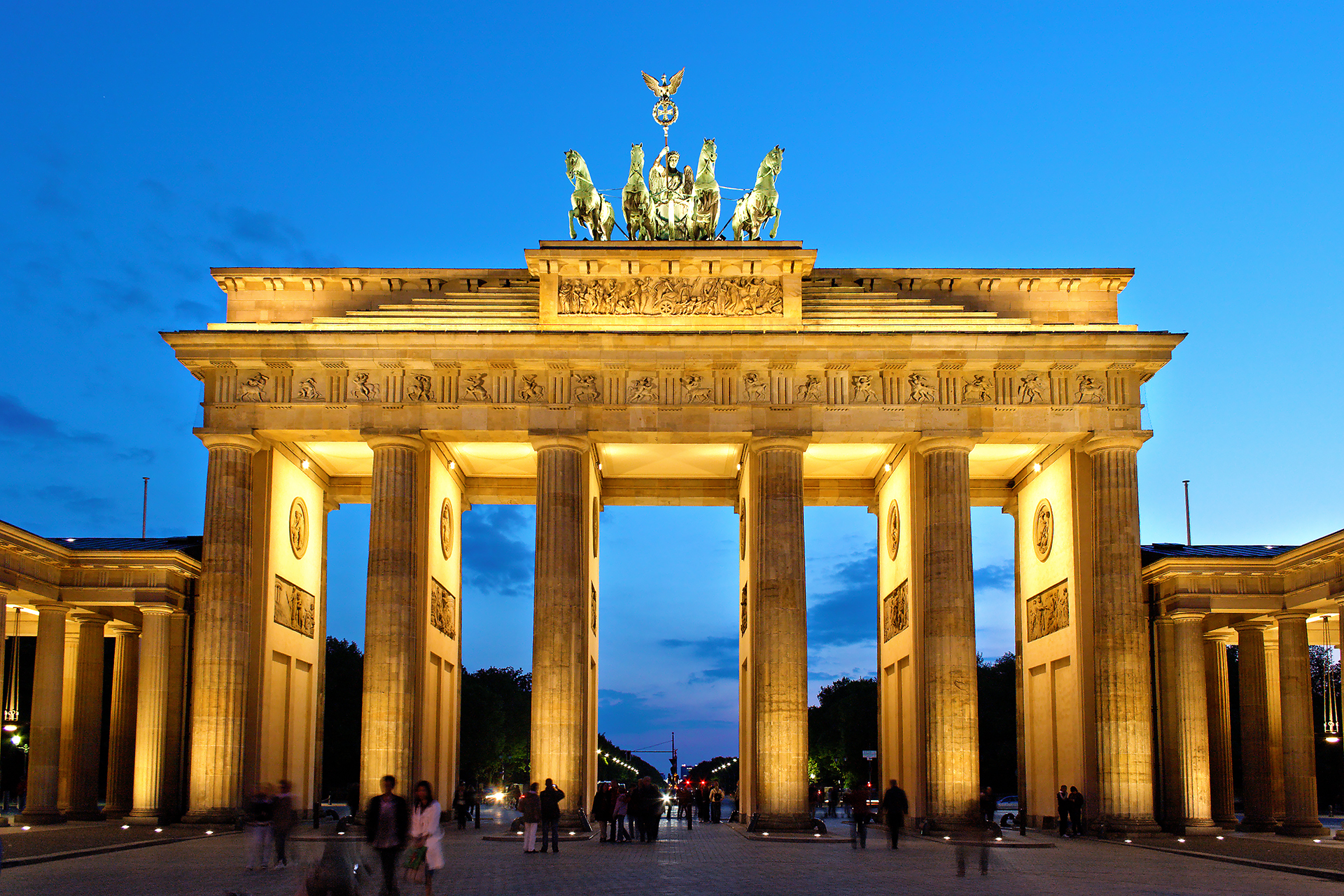
Photos: א (Aleph) Creator: Johann Gottfried Schadow (CC BY-SA 2.5), Thomas Wolf, www.foto-tw.de (CC BY-SA 3.0), Thomas Wolf, www.foto-tw.de (CC BY-SA 3.0), via Wikimedia Commons
See it, because you will walk past it anyway and it is the single most loaded landmark in the city. Just do not build your day around it. It is a fifteen-minute stop best chained together with the Reichstag and the Holocaust Memorial right next door, and it is far better early or at night than at noon.
Worth it for
- First-time visitors who want the postcard shot and the Cold War history in one spot
- Anyone walking the government quarter and Unter den Linden
- Evening strolls when it is floodlit and quiet
You can skip if
- You are short on time and only care about things you can go inside
- You hate dense tour-group crowds and can only come at midday
Tickets & tours for Brandenburg Gate
Which ticket should you buy?
What it is
The Brandenburg Gate is a neoclassical arch built at the end of the 1700s, modeled loosely on the entrance to the Acropolis. Six columns, five passages, and on top the Quadriga: Victory driving a chariot pulled by four horses. Napoleon hauled the chariot off to Paris in 1806, and it came back a few years later, which is the kind of back-and-forth that fits this gate perfectly.
What makes it matter is the second half of its life. For most of the Cold War it stood marooned in the death strip, just behind the Wall, unreachable from either side. When the Wall came down the crowds gathered here. So it reads as a symbol of division and then reunification, which is a lot of meaning packed into one arch. You feel some of that standing in front of it even if you skip the history reading.
What to see
The gate itself, the Quadriga up top, and the open square of Pariser Platz around it, framed by embassies (the French and US ones flank it), the Adlon hotel, and the Academy of Arts. Look down Unter den Linden on one side and toward the Tiergarten on the other, and you get the whole axis of central Berlin in one turn of the head.
Tucked into the north wing is the Raum der Stille, a small room of silence open to anyone, free, usually mid-morning to early evening. It is a genuinely quiet break from the square outside if you want one. Otherwise there is not much to do beyond stand, look, and move on to the Reichstag and the Holocaust Memorial, both a few minutes' walk away.
Visiting and access
Free, open all day every day, no ticket and no gate (ironically). The fastest way in is the U5 to Brandenburger Tor, which also connects to S-Bahn lines S1, S2, S25 and S26 at the same station. You come up the stairs and the gate is right there.
A warning worth taking seriously: this square draws pickpockets and a few low-grade scams. People in fake costumes or 'soldiers' will push you to pose and then demand money, and someone may try to hand you a clipboard petition as a distraction. Keep your bag zipped and in front of you, say no and walk, and you will be fine.
Brandenburg Gate: FAQs
Yes. It is an open public monument with no ticket, no booking and no opening hours. You can walk up to it at any hour, and the square around it stays accessible day and night.
No, there is no interior to tour and no way up to the Quadriga. The one indoor space open to the public is the small Room of Silence in the north wing, usually open mid-morning to early evening, also free.
Brandenburger Tor, served by the U5 U-Bahn line and the S1, S2, S25 and S26 S-Bahn lines. The exit puts you right at the gate. Unter den Linden station on U5 and U6 is also a short walk away.
Early morning before about 9 or after dark when the floodlights are on and the tour buses have gone. Midday is the most crowded and the least pleasant for pictures.
Fifteen to thirty minutes covers it. Since the Reichstag and the Holocaust Memorial are both a few minutes away on foot, most people fold the gate into a single walk through the government quarter.
Yes. Costumed 'soldiers' or characters pose for photos then demand cash, and pickpockets work the crowds. Keep your bag closed and zipped, decline clipboard petitioners, and do not pay anyone who pressures you after the fact.
Explore more in Berlin
Plan your trip
- Best time to visit Berlin
- Day trips from Berlin
- One day in Berlin: the essential first pass
- Two days in Berlin: the sights, then the city itself
- Three days in Berlin: history, neighborhoods, and a slower west
- Berlin with kids: what actually holds their attention
- Berlin at night, from a calm rooftop to four in the morning
- Berlin when it rains: where to go when the sky opens up
- Reichstag Dome vs TV Tower: Which Berlin View to Pick
- Neues Museum vs the Pergamon Panorama: Museum Island in 2026
- Kreuzberg vs Prenzlauer Berg: Where to Stay in Berlin
Where to next?
One short email, twice a month: handpicked experiences, hidden-gem cities, and the best windows to book them.