 Klemio
Parthenon
The Parthenon is the marble temple to Athena that sits at the top of the Acropolis, finished in the 5th century BC and arguably the most influential building in Western architecture. You cannot go inside, you view it from the surrounding plateau, and there is usually some restoration scaffolding on it, but the scale and the precision of the thing up close still land. There is no separate Parthenon ticket: it comes with Acropolis entry, so book a timed Acropolis slot.
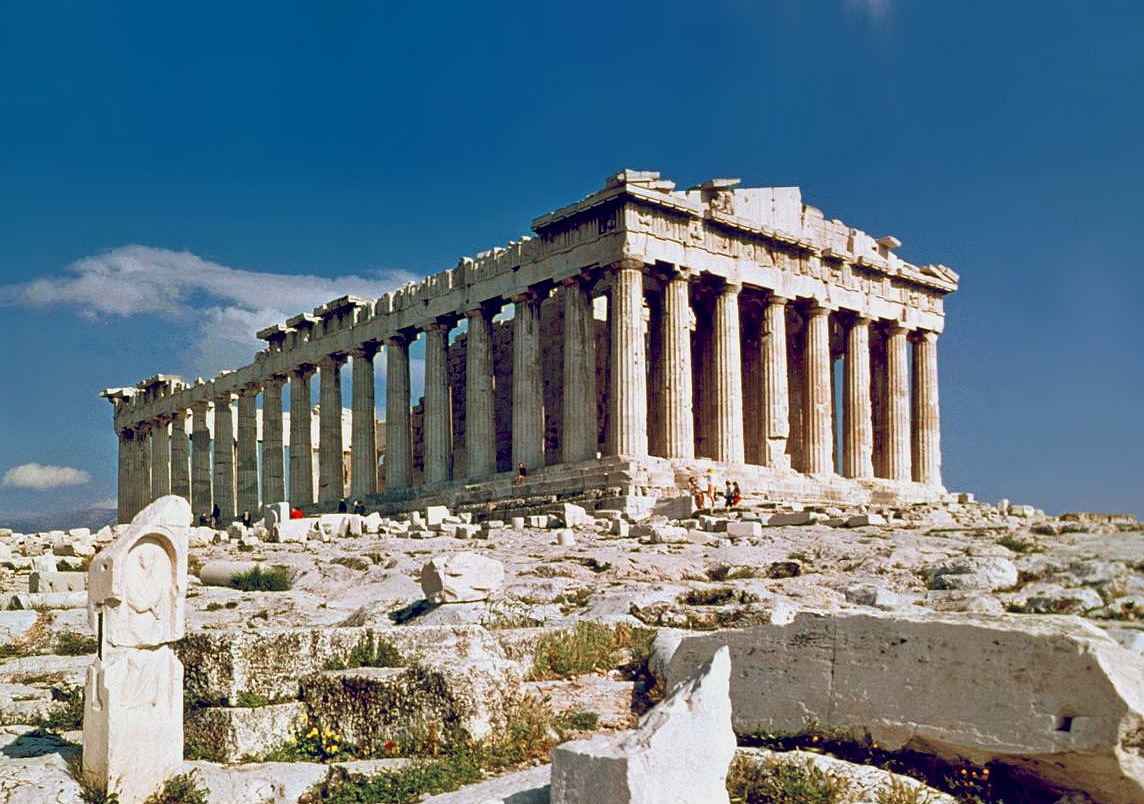
Photos: Thermos (CC BY-SA 2.5), A.Savin (CC BY-SA 3.0), Jebulon (CC0), via Wikimedia Commons
Yes, see it, but set your expectations: you admire it from outside, scaffolding is likely, and it shares a ticket with the whole hill. None of that takes away from standing next to a 2,500-year-old temple that still defines what a building should look like. Go early or late and walk all the way around it.
Worth it for
- Anyone climbing the Acropolis, since it is the centerpiece
- Architecture and history enthusiasts who care about the details up close
- Photographers working the morning or golden-hour light
You can skip if
- You expected to go inside or see it without any restoration work
- You are not climbing the Acropolis at all, since there is no other way to reach it
Tickets & tours for Parthenon
Which ticket should you buy?
What it is
Built in the decades after 447 BC under Pericles, the Parthenon was a temple to Athena, the city's patron goddess, and once held a giant gold-and-ivory statue of her that has long since vanished. What survives is the marble shell: the columns, the surviving sculpture, and the famous optical refinements. The columns lean slightly inward and bulge subtly in the middle, the floor curves, and there are almost no truly straight lines, all of it tuned by eye so the building reads as perfectly regular from a distance.
It has been a temple, a church, a mosque, and a gunpowder store that blew up in 1687, which is why it is a ruin rather than an intact building. The restoration you see today is a long, painstaking project to undo bad earlier repairs and put original blocks back where they belong.
What to see and where to stand
You circle the temple on the open hilltop rather than entering it. Walk all the way around: the west and east ends frame differently in photos, and the morning light hits the east front while late afternoon warms the marble to honey. Look for the carved metopes high on the entablature and the surviving column drums showing how the pieces were stacked and pinned.
For the classic full-temple shot without standing right under it, head to the Areopagus rock just outside the main entrance, or further off to Filopappou Hill across the way. Both give you the Parthenon at a distance with the city behind it.
Restoration and access
Expect scaffolding somewhere on the building. The restoration is ongoing and the cranes and props move around the facades over time, so the exact view changes month to month. Most of the structure is usually visible, but a fully scaffold-free Parthenon is not guaranteed on any given day.
Access is the same as the rest of the Acropolis: a climb up worn marble paths and steps, very little shade, and slippery footing in the rain. The summit ground is uneven, so watch your step while you are looking up.
Parthenon: FAQs
No. You view it from the surrounding plateau and walk around it. The interior is roped off for preservation and because of ongoing restoration work.
No. The Parthenon is part of the Acropolis, so your timed Acropolis ticket covers it. There is no standalone Parthenon entry.
Centuries of reuse and one disaster: it served as a temple, church, and mosque, then a Venetian bombardment in 1687 ignited gunpowder stored inside and blew out much of the structure.
Probably some. Restoration is continuous and the scaffolding shifts around the building over time. Large stretches are usually visible, but a completely clear view is not guaranteed.
Up close on the hilltop for scale, or from the Areopagus rock and Filopappou Hill nearby for the whole temple with the city behind it. Early morning and late afternoon give the best light.
Many are in the Acropolis Museum at the foot of the hill, and a large portion of the frieze is held in the British Museum in London. The carvings on the temple itself are mostly weatherproof copies.
Explore more in Athens
Plan your trip
- Best time to visit Athens
- Day trips from Athens
- One Day in Athens
- Two Days in Athens
- Three Days in Athens
- Athens with Kids: What Actually Holds Their Attention
- Athens at Night: Where to Go After the Sites Close
- Athens When It Rains: The Indoor Plan That Doesn't Feel Like a Compromise
- Acropolis Museum vs National Archaeological Museum: Which One If You Only Pick One
- Mount Lycabettus vs Philopappos Hill: Where to Watch the Athens Sunset
- Plaka vs Monastiraki: Where to Stay in Central Athens
Where to next?
One short email, twice a month: handpicked experiences, hidden-gem cities, and the best windows to book them.